
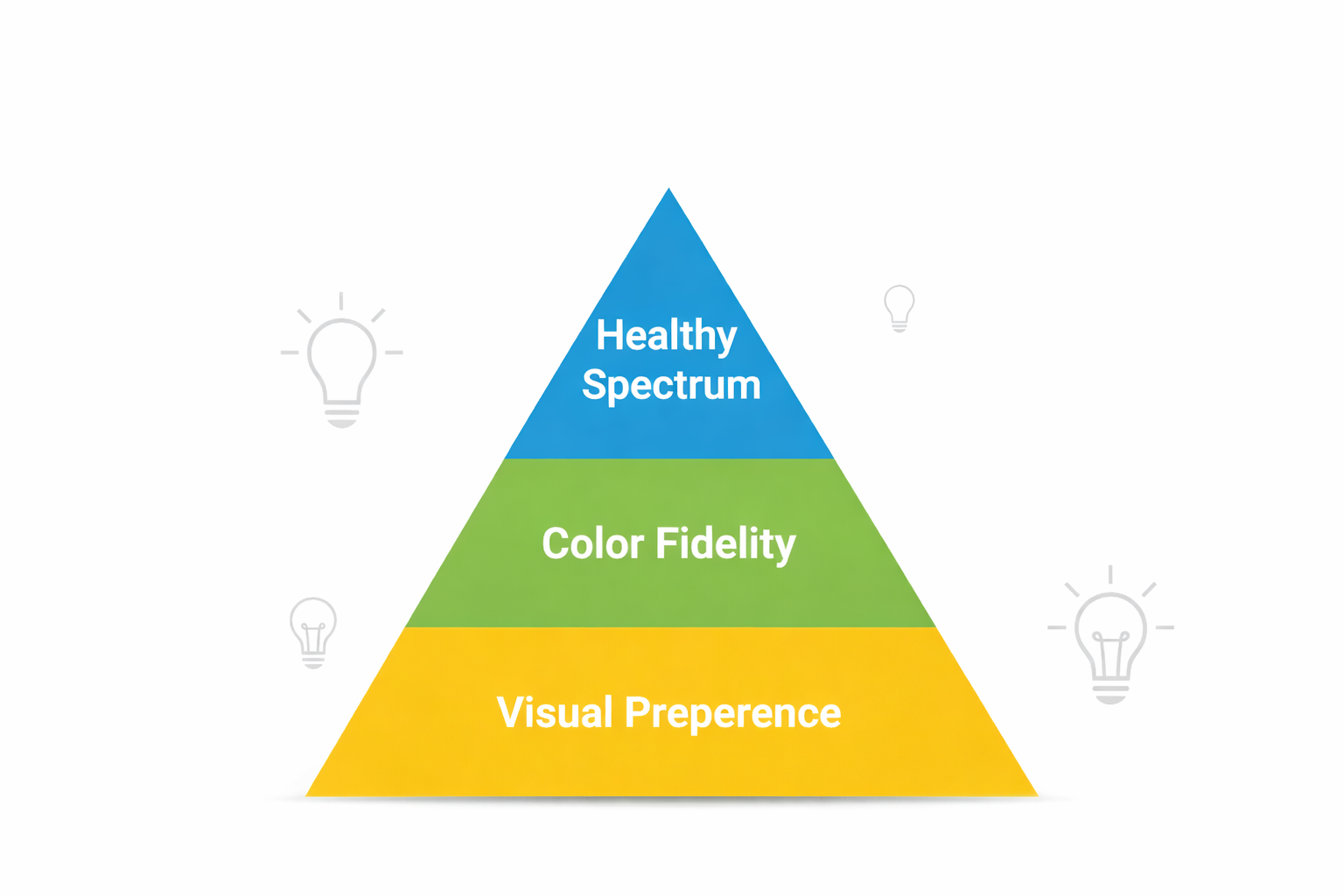
What Does the Human Body Need: “Specialized Light Color” or a “Healthy Spectrum”?
December 3, 2025
Visit a lighting store and you’ll likely see a familiar environment: warm, rosy light that makes everything from skin tones to furniture look softer, brighter and more attractive. Store employees will also explain that these “specialized light colors” are more comfortable, healthier and can even improve your mood.
The important question is: Does your body need this flattering, filtered light?
Or is your health – your eyes, sleep cycle, energy levels and long-term well-being – better off with a scientifically balanced, healthy light spectrum?
Let’s set the record straight about the myths of lighting marketing and discover what modern lighting science (and ACE’s engineering mindset) have to say about light and the human body.
That beautiful “rosy glow” effect has a scientific name: the Helmholtz–Kohlrausch (H-K) effect. It tricks the brain into perceiving highly saturated colors (like boosted red) as brighter, even if actual brightness hasn’t increased.
To create this effect, some lights artificially increase red wavelengths and reduce blue and green. It’s visually pleasing—but at a cost:
1. Distorted Color Reality
Over-amplified red makes:
-
Blues appear gray
-
Greens look dull
-
Skin tones appear “filtered,” not natural
-
Food, art, and décor lose their true colors
Lighting’s purpose is to reveal reality, not to distort it.
ACE avoids these shortcuts. Instead, ACE uses balanced, continuous-spectrum lighting, ensuring all colors—reds, greens, blues—remain accurate and vibrant.
2. Misleading Claims About “Standard” Light
Some manufacturers argue that standard white light is naturally “greenish.”
This is false.
The greenish tint comes from cheap LED chips that concentrate output in the yellow-green band to maximize luminous efficacy—sacrificing red phosphors to cut costs.
“Special reddish light” is often not innovation—it’s a patch to cover poor spectral design.
CRI (Ra) only measures how well a light reproduces 8 pastel colors.
Modern lighting requires more complete metrics.
The TM-30 Standard Shows the Full Picture
TM-30 uses 99 color samples, providing two crucial values:
-
Rf (Fidelity): Accuracy of color reproduction
-
Rg (Gamut): How saturated colors appear
Ideal healthy light:
-
Rf ≥ 90
-
Rg ≈ 100
And don’t forget R9, which measures deep red—essential for:
-
Skin tones
-
Food freshness
-
Warm materials
Many high-CRI “special red” lights still fail R9.
Our full-spectrum products consistently deliver R9 ≥ 50–80, along with high Rf/Rg performance.
Light isn’t just for seeing.
Your eyes contain a third system beyond rods and cones:
ipRGCs — The Cells That Control Your Biological Clock
These cells detect light to regulate the circadian rhythm, sending signals to the brain’s master clock (SCN).
The key trigger?
480 nm Blue-Cyan Light — Your Body’s “Wake-Up Signal”
During the day, blue-cyan light:
-
Suppresses melatonin
-
Boosts focus and alertness
-
Supports mood
-
Regulates hormone production
At night, reduced blue-cyan light:
-
Allows melatonin to rise
-
Helps you relax and sleep naturally
The Problem with Static “Reddish” Light
To create that warm, rosy tint, manufacturers often reduce blue-cyan wavelengths—the very wavelengths your body needs during the day.
Daytime use → low alertness, fatigue, lowered productivity
Nighttime use → acceptable, but still a fixed spectrum that can’t adapt
Your biology requires dynamic, time-of-day-appropriate lighting—something that fixed “filter-style” lights cannot provide.
1. Full Spectrum: The Foundation
A healthy spectrum resembles natural daylight:
-
Continuous curve across all wavelengths
-
No extreme spikes or gaps
-
Authentic, balanced color rendering
ACE produces professional full-spectrum solutions as a baseline for visual and biological comfort.
2. Circadian-Aware, Human-Centric Lighting (HCL)
But full spectrum alone is not enough.
Healthy lighting must deliver:
-
Dynamic color temperature (cooler in the day, warmer at night)
-
Right levels of melanopic light (EML/m-EDI)
-
Managed blue light dosage
-
Proper integration with space usage and occupancy patterns
When evaluating lighting:
✔ Check Color Rendering Quality
-
Ra ≥ 90
-
R9 ≥ 50
-
Rf ≥ 90
-
Rg ≈ 100
✔ Check Duv (Color Accuracy)
-
Target Duv ≈ 0
-
Avoid green or pink tints
✔ Review the Spectrum
A real spectrum report should show smooth continuity—not gaps or spikes.
ACE provides laboratory-verified spectral reports for every product, backed by a CNAS-accredited testing facility.
✔ Seek Dynamic Control (If Possible)
Choose adjustable color temperature to support:
-
Productivity during the day
-
Relaxation at night