
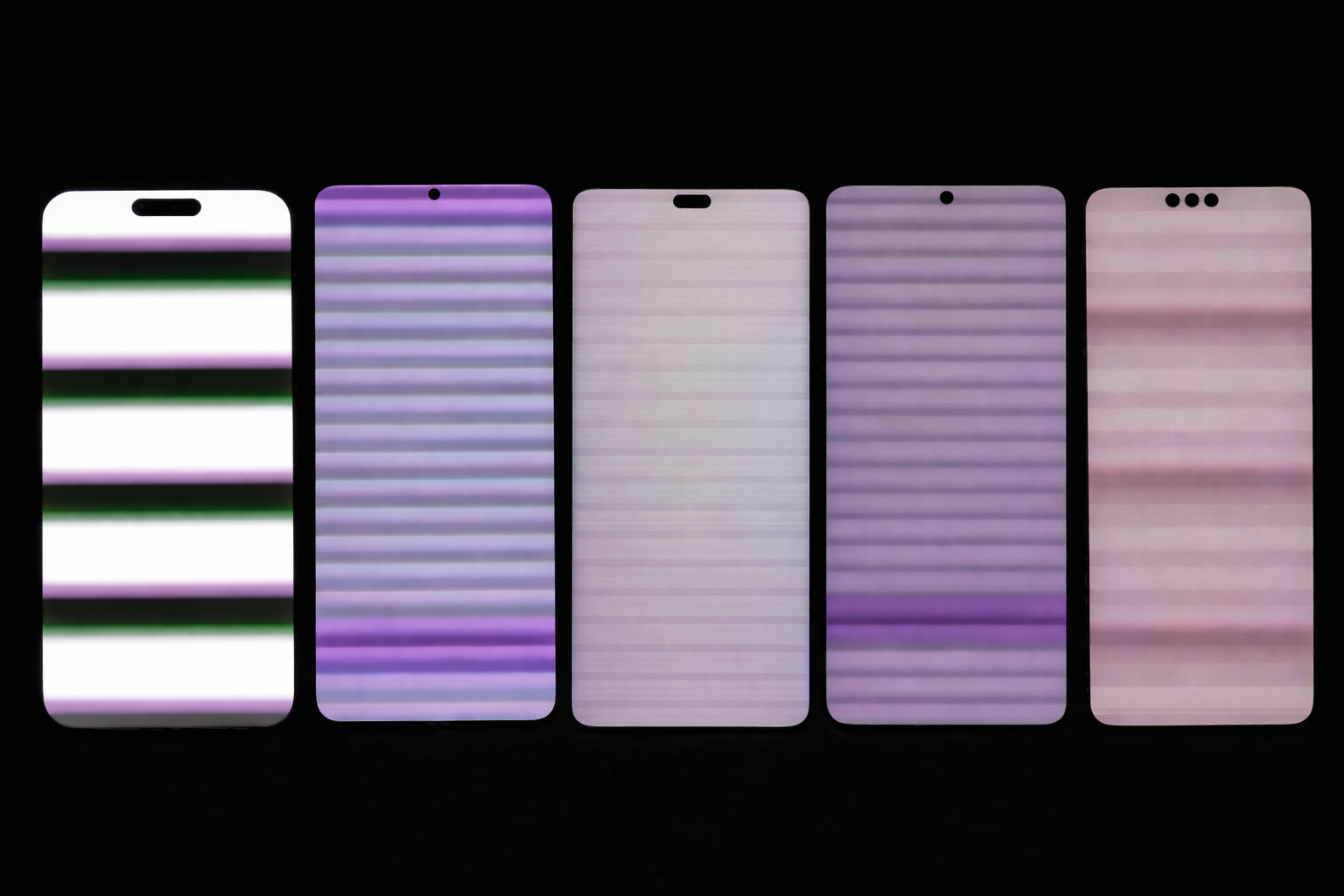
Phone Captures Flickering Lights? It Doesn’t Mean the Light Is Bad!
December 30, 2025
Take out your phone, point it at a ceiling light, snap a photo—and suddenly, your screen shows rolling black bars, flashing waves, or chaotic flicker.
The immediate reaction?
“This light is flickering! It must be low quality!”
But here’s the surprising truth:
Flicker shown on your phone camera does NOT mean the light is harmful to your eyes.
Most of the time, it’s simply a technical mismatch between how your camera works and how your eyes work.
It’s important to know the difference (which comes up a lot, especially on social media, where lighting myths travel fast). For major lighting manufacturers such as ACE, who run CNAS accredited labs and supply industrial, agricultural and commercial lighting solutions worldwide, it’s vital to know the difference between actual flicker and camera-induced illusions.
Let’s break down the science clearly and simply.
Your eyes and a smartphone camera use completely different systems to analyze the world.
Your Eyes: Nature’s Built-In “Flicker Filter”
The human visual system has something called persistence of vision, which blends fast flashes into a smooth image.
If light flickers faster than around 80Hz, your brain “stitches” it together into continuous illumination.
This means:
-
A 100Hz or 120Hz LED light?
Your eyes see stable light. -
A 2,000Hz PWM-dimmed light?
Still stable to your vision.
Your eyes automatically smooth out anything faster than your biological threshold.
Your Phone: A Brutally Honest Sampling Machine
A camera has no such smoothing.
It captures reality in tiny time slices, dictated by:
-
shutter speed
-
frame rate
-
rolling shutter scanning
-
sensor readout timing
So when a light pulses—even at 100Hz, 1,000Hz, or 20,000Hz—your phone will record those fluctuations as:
-
rolling black bars
-
dark stripes
-
strobing waves
-
inconsistent brightness
Your phone isn’t diagnosing lighting quality.
It’s simply capturing timing mismatches between:
the light’s pulse frequency → and → your camera’s capture speed.
All electrical lights fluctuate in brightness.
That part is normal.
But it’s the type of fluctuation that matters.
Three common reasons lights fluctuate:
1. AC Power Supply (The Natural Pulse)
Power grids alternate 50 or 60 times per second.
This creates brightness waves at:
-
100Hz (in 50Hz regions)
-
120Hz (in 60Hz regions)
Safe for the human eye, but very visible to a camera.
2. LED Driver Quality (The Real Differentiator)
Cheap drivers produce current ripple, causing noticeable flicker and possible eye strain.
High-quality drivers—like those used in ACE LED products—convert AC to DC smoothly and keep flicker far below harmful thresholds.
3. PWM Dimming (Fast On-Off Cycling)
Pulse-Width Modulation switches LEDs on and off thousands of times per second.
-
Eyes: see it as perfectly smooth dimming
-
Phones: capture the “off” frames → stripes appear
Cameras make flicker appear exaggerated due to:
Fast shutter speeds
Your camera may capture a moment when the light is at a dip in brightness.
Frame rate mismatch
30FPS video vs. 100Hz or 120Hz lighting → “gear teeth” misalignment → rolling bands.
Rolling shutter effect
Your phone scans the image line by line, not instantaneously.
Brightness changes during this scan → uneven brightness across the frame.
This is why slow-motion videos or certain phone models show flicker more dramatically.
Using your phone to “test flicker” is like using a ruler to measure temperature—wrong tool, wrong purpose.
Reason 1: No Scientific Measurement
Flicker health impact must be measured using:
-
Flicker Percent
-
Flicker Index
-
SVM (Stroboscopic Visibility Measure)
-
PstLM (short-term perception of flicker)
Your phone measures none of these.
Reason 2: Zero Consistency
The same light can appear:
-
“bad” on an iPhone with fast shutter
-
“perfect” on an older Android
No standard = no reliability.
Reason 3: Wrong About What’s “Harmful”
Phones often show:
-
Safe high-frequency flicker → looks terrible on camera
-
Potentially harmful low-frequency ripple → hard for phones to capture
In other words:
Your phone may fail to show the dangerous flicker and exaggerate the harmless one.
Professional assessments require:
✔ Flicker meters / high-speed spectrometers
Measure millions of samples per second.
✔ Standards from IEEE, IEC, CIE
Industry-defined thresholds for safe lighting.
✔ Correct testing angle
Vertical surfaces reveal more flicker due to mixed reflections and beat frequencies—something ACE engineers consider in lighting design.
✔ CNAS-accredited laboratory testing
ACE LED conducts all flicker, SVM, and PstLM testing in-house with ISO 17025–certified equipment.
The industry is improving from both sides:
Lighting Technology
Modern, stable drivers and camera-friendly dimming are becoming standard.
ACE’s solutions, including its A-HE01 and other industrial lines, are engineered to eliminate harmful flicker while minimizing camera artifacts.
Camera Technology
Upcoming global shutter sensors capture the entire frame at once—no scanning rows, no rolling bands.
Once mainstream, phone-captured flicker will virtually disappear.